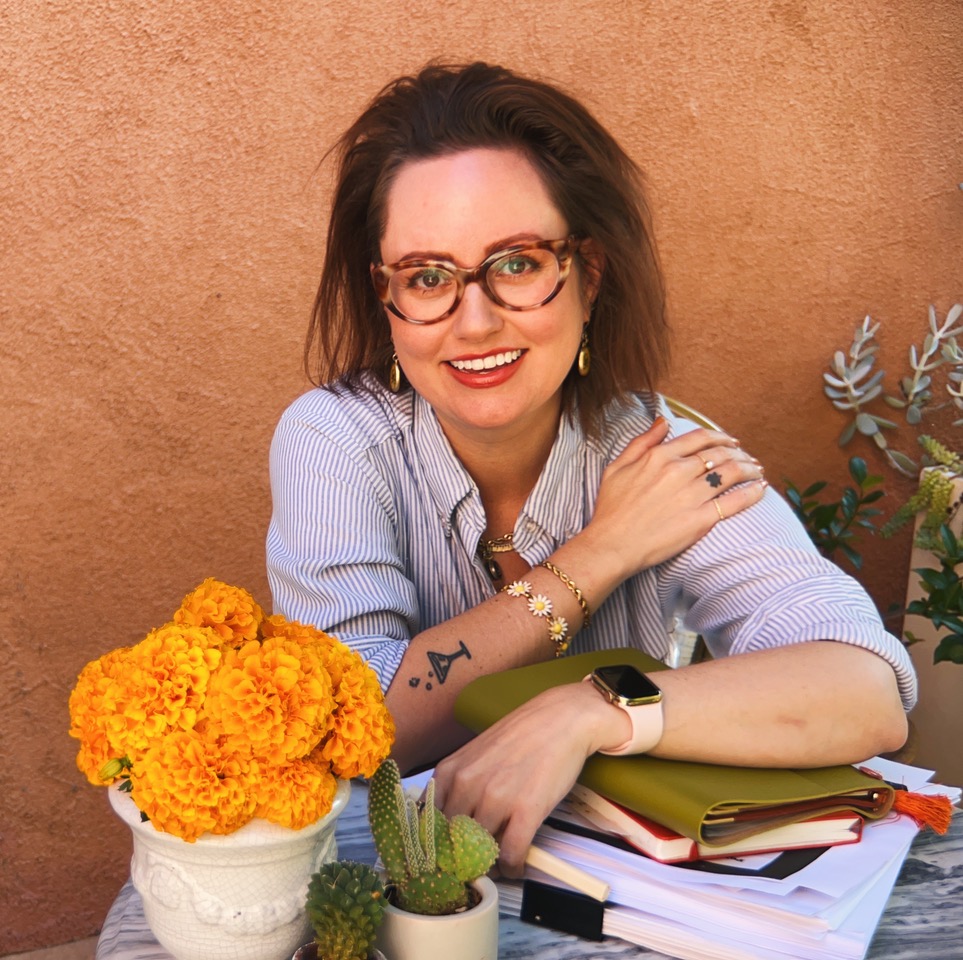
Cole Imperi
What’s the episode about?
In this episode, hear Cole Imperi on grief, thanatology, shadow loss, and non-clinical tools in support of those experiencing loss and grief.
Who is Cole?
Cole Imperi is a thanatologist, award-winning author, and researcher whose work focuses on the use of non-clinical tools in support of those experiencing loss and grief.
Cole is the Founder of the School of American Thanatology, which has students in more than 30 countries, where she both teaches and conducts research under the school’s ThanaLab. Through her development of Shadowloss Theory and her pioneering work with the field of Thanabotany, Cole’s work seeks to bridge the gaps left by the decline in non-clinical, community-led bereavement support.
As a leading expert in the field of thanatology, Cole has given multiple TEDx Talks on Shadowloss and resiliency, appeared on the Netflix series The Future of…, and served as an expert for WNYC’s Radiolab, The Atlantic, The New York Times, Ologies, MoMA, and more.
Cole’s is the author of A Guide to Grief, for teens and tweens, and a book about grief for adults called Grief is the Way Home being published by Penguin in 2027.
Cole has diverse experience from working in and around loss and grief since 2008 where she worked as a chaplain-thanatologist in one of America’s 25 largest jails, mortuary college professor, crematory operator, hospice volunteer, grief support group leader for children as young as 3 to adults, death companion, served on the board of a green burial startup, and as Board President of a historic cemetery and arboretum. She traveled the US and Canada for 5 years training funeral directors and embalmers, and co-founded a deathcare startup. She currently consults on bereavement programming for organizations, and publishes the popular column Grief or Madness.
Cole was the recipient of the Curtis Gates Lloyd Fellowship through the Lloyd Library and Museum, is a California Master Gardener, and a California Master Food Preserver. She works as a horticulturalist one morning a week specifically for a Hummingbird Garden, which gives her a break from life behind a computer screen.
She is based in Los Angeles.
The Book Promo: Decolonising Death Studies
You can find the book promoted in the introduction here.
Panagiotis: Hello, I’m Panagiotis Pentaris. We’re excited to introduce our new edited collection, Decolonising Death Studies. This book emerges from a simple but urgent truth: the way we understand death, dying, and bereavement has been shaped for far too long by Western frameworks and monodisciplinary perspectives. That narrow lens limits how we support people and communities around the world.
Stacey: Hi, I’m Stacey Pitsillides. What we’ve created is a space where diverse voices – especially those historically under‑represented – can speak back to the assumptions that dominate the field. Death is universal, but the ways that we grieve, care, ritualise, and remember are profoundly cultural and distributed.From rituals to repatriations, the politics of remembrance in the Anthropocene to queer and trans experiences of loss – this book examines how death reflects culture, power, and resistance across the world.
Hajar: Hi, and I’m Hajar Ghorbani. Our contributors come from across continents and disciplines, offering perspectives that push the boundaries of what death studies can be, and challenge the idea that one worldview can – or should – define the entire field of research, theory, and practice. Together, we explore how colonial legacies still shape research, policy, and practice, and we highlight methodologies that centre community knowledge, plurality, and lived experience.
Panagiotis: Decolonising isn’t just a concept – it’s a practice. It asks us to rethink who gets to produce knowledge, whose stories are valued, and how we can build a field that genuinely serves the people it claims to understand.
Stacey: So, whether you’re a student, researcher, practitioner, or simply someone curious about how culture shapes our encounters with mortality, this book offers new ways of seeing and engaging with death. It’s interdisciplinary, international, and intentionally disruptive.
Hajar: We hope it sparks conversations, challenges assumptions, and opens doors for more inclusive, transformative scholarship. Because death studies should reflect the world we live in – not just a fraction of it.
Stacey: We look forward to building a decolonised future of death studies together!
Hajar: Happy reading!
Where can I listen?
How do I cite the episode in my research and reading lists?
To cite this episode, you can use the following citation:
Imperi, C. (2026) Interview on The Death Studies Podcast hosted by Michael-Fox, B. and Visser, R. Published 1 March 2026. Available at: www.thedeathstudiespodcast.com, DOI: 10.6084/m9.figshare.31440127
What next?
Check out more episodes or find out more about the hosts! Got a question? Get in touch.